Action Camera Matching Guide: Sports, Driving, Photo/Video
Matching an action camera to a workflow is a specification exercise, not a ranking exercise. Across the five YUAOHENG models covered here, the differences that decide a project are capture geometry, stabilization, low-light hardware and screen size. On the specifications supplied for this guide: the X20 is the night-capable outdoor option, with four built-in infrared lights and manual IR switching; the Q1 and Q3 record two perspectives at once from a single body; the Q2 adds 6-level electronic image stabilization, a 1.8-inch 800×480 screen and touch plus physical buttons for high-vibration and wet work; and the Q7 belongs to the same lineup and certification scope, but its model-level parameter set was not part of the supplied data, so it is treated here as a datasheet-confirmation item rather than a recommended configuration.
This guide is written for importers, own-brand program managers and project buyers who have moved past first discovery into Research and Evaluation — the stage where a configuration, a mounting plan and an acceptance procedure have to be fixed before an order is issued. It works through the three scenarios named in the brief, then closes with commercial terms and the checks that should be completed on a sample.
Why one action camera body rarely covers three workflows
The three scenarios stress different parts of the same product. Outdoor sports load the mounting interface, the lens angle and low-light behaviour: a helmet, chest or bar rig needs the lens re-aimed after mounting, which is why the X20, Q1 and Q3 are all specified with a rotating 130° wide-angle lens. Driving and transportation stress simultaneity — the useful record is often a pair of frames, the road ahead and the cabin or cargo behind — which is a dual-recording requirement, not a resolution requirement. Photography and video shooting stress the operator loop: framing, reviewing and re-shooting, which is where screen size, screen resolution and button layout move from comfort details into procurement criteria.
Power is the fourth variable, and the one buyers most often flatten into a single number. The supplied data set contains three different configurations: a 1000mAh/3.8V polymer battery in the X20, a 2000mAh/3.8V polymer battery in the Q1 and Q3, and an 18650 cell rated 2000mA in the Q2. The runtime figures are quoted against different modes — video, recording, and a 720p 30fps reference — so they cannot be treated as interchangeable between models or between suppliers.
Industry background: what the 2026 action camera market says about scenario fit
Two published figures frame the buying context. Outdoor sports and recreation applications — cycling, skiing, surfing and diving — accounted for a 46% share of the global action camera market in 2025, according to Fortune Business Insights. In the same year, cameras at 4K and above held 49.50% of market revenue, according to Global Market Insights. Those two numbers point in different directions for a project buyer: demand is concentrated in outdoor use, while revenue is concentrated in the 4K tier. A program that needs night-capable outdoor recording, dual-perspective capture or a specific stabilization level does not automatically need the top resolution tier — it needs the configuration that produces the required footage reliably at the site conditions it will actually meet.
Supply is concentrated as well. IDC's Q2 2026 handheld camera tracker, as cited in Photography Talk's reporting, places DJI and Insta360 at 93% of global handheld camera shipments, a category covering action, 360 and gimbal cameras. For the non-flagship tier that most importers and private-label programs buy from, the basis of selection therefore moves away from brand comparison and toward documented configuration fit, certification coverage and acceptance testing.
Compliance context matters at the same stage. YUAOHENG action camera models — including the X20, Q1, Q2, Q3 and Q7 — are listed as holding CE certificate CISRC251111081V1 and RoHS compliance under EU 2015/863 in HTNXT Research's certification guide, with the Q2 listed under FCC ID 2BR43-Q3 and the X7 under FCC number CQASZ20260601273E-01. Action cameras are classified under HS code 8525.80. Certificate numbers should be matched to the exact model and revision on the commercial invoice, not to the product family as a whole.
The five models at a glance
The table below uses only the parameter fields supplied for each model. Where a field is absent, it is marked as absent rather than inferred.
| Model | Screen | Lens and recording (as listed) | Low light and stabilization | Power | Best-fit signal |
|---|---|---|---|---|---|
| X20 | 1.54-inch IPS, 320×240 | 130° HD lens, rotating direction; resolution field listed as AVI (1920×1080); model designated 2K+WiFi | Four built-in infrared lights, manual switching | 1000mAh/3.8V polymer; about 6–7 h video; about 9 h recording; about 12 h at 720p 30fps | Night-capable outdoor recording where 4K is not required |
| Q1 | 1.5-inch IPS, 320×240 | 130° wide angle, rotating; front 4K (3840×2160); rear 4K; simultaneous dual recording front 2K + rear 2K | Infrared night vision supported; compatible with waterproof case | 2000mAh/3.8V polymer; about 4–5 h video; about 9 h recording; about 10 h at 720p 30fps | Dual-perspective sports and driving with published runtime |
| Q2 | 1.8-inch IPS, 800×480 | 25mm lens, 130° wide angle; front 4K; rear 4K; simultaneous 2K+2K; three modes optional | 6-level electronic image stabilization; infrared supported; compatible with waterproof case; touch plus physical dual buttons | 18650 cell rated 2000mA; about 4–5 h video | High-vibration and wet work with on-set review |
| Q3 | 1.5-inch IPS, 320×240 | 130° wide angle, rotating; front 4K; rear 4K; simultaneous dual recording front 2K + rear 2K | Infrared night vision supported, manual switching | 2000mAh/3.8V polymer; runtime not stated in supplied data | Dual-perspective driving or fixed rigs with operator-controlled IR |
| Q7 | Not in the supplied specification set | Not in the supplied specification set | Not in the supplied specification set | Not in the supplied specification set | Lineup member within the same CE/RoHS scope; confirm datasheet before specifying |
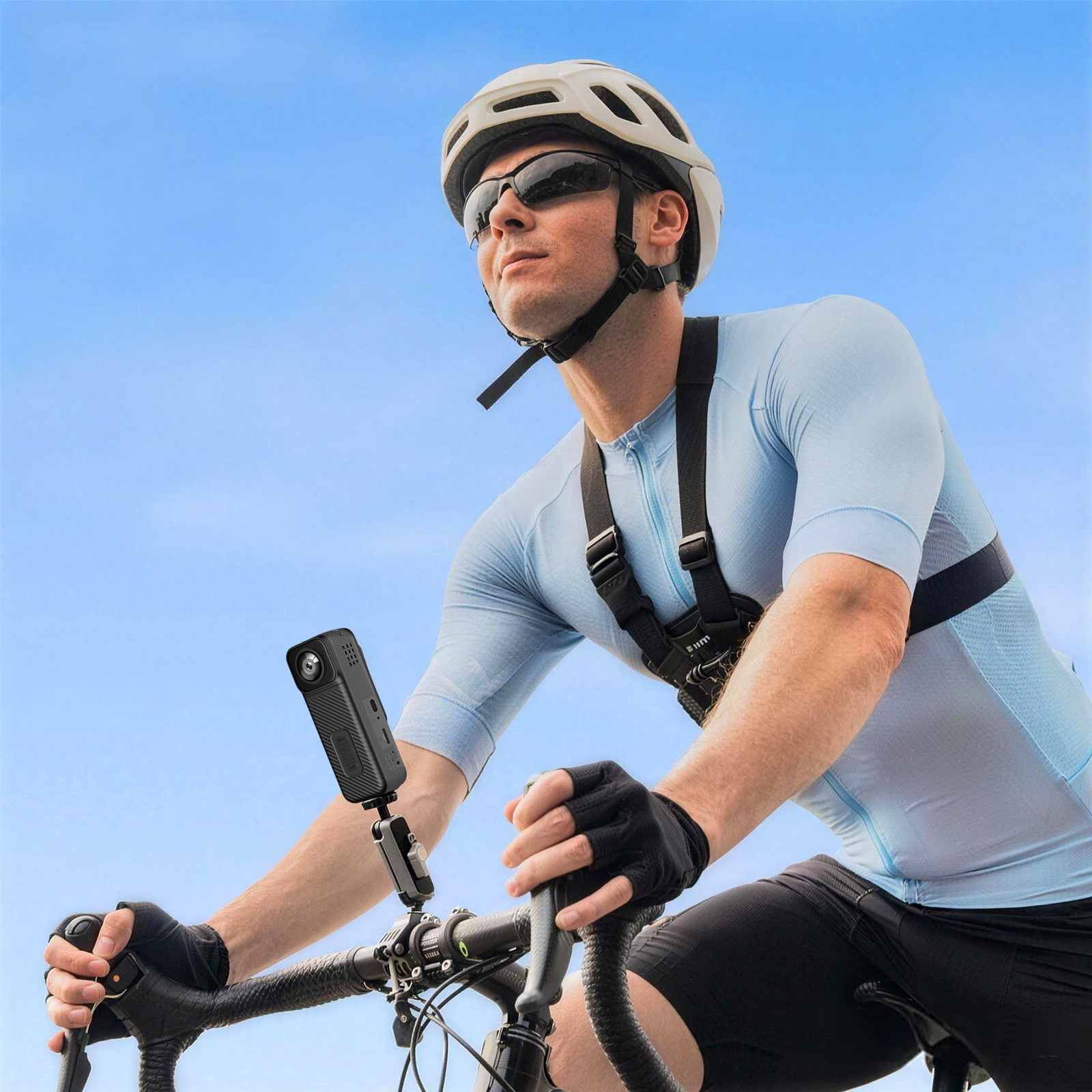
A cycling-mounted action camera rig: bar and helmet mounts are the mounting cases where a rotating wide-angle lens and a documented stabilization level change the output most.
Scenario 1 — Outdoor sports: mounts, vibration and low light
The X20 is the model in this set built around low-light outdoor recording. Its product data lists four built-in infrared lights with manual switching, a 1.54-inch IPS screen at 320×240, a rotating 130° HD lens, a 1000mAh/3.8V polymer battery, and optional 16GB, 32GB, 64GB or 128GB storage. Manual infrared switching is the operationally relevant detail: the operator decides when the infrared array is on, rather than leaving that decision to a fixed automatic rule at dusk on a climb or in a shaded gully. Stated runtime is about 6–7 hours of video, about 9 hours in recording mode, and approximately 12 hours at 720p 30fps — the longest video figure in this group, carried on the smallest battery, which is exactly why the test profile has to be repeated on your own settings before those figures are used for planning.
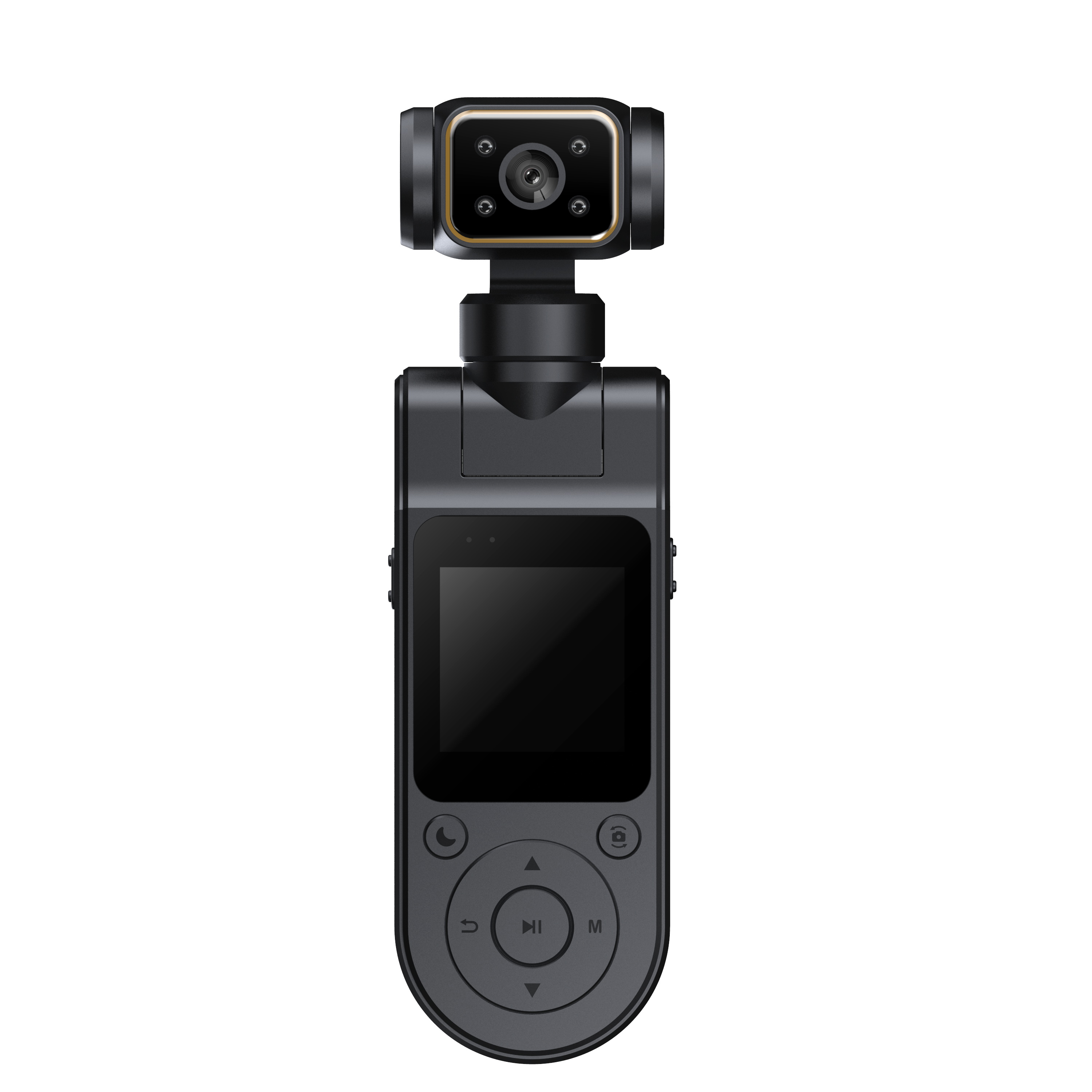
The X20 carries four built-in infrared lights with manual switching — a low-light feature that is set by the operator, not by an automatic rule.
For cycling, skiing or any sport where the interesting frame can be in front of or behind the wearer, dual recording changes the shot list rather than just the file count. The Q1 records front 4K at 3840×2160 and rear 4K, and can record front 2K plus rear 2K simultaneously. It lists a 2000mAh/3.8V polymer battery, about 4–5 hours of video, about 9 hours in recording mode, approximately 10 hours at 720p 30fps, compatibility with a waterproof case for waterproof shooting, infrared night vision support, a full-range built-in capacitor microphone and a high-speed Mini USB 2.0 interface. For a two-angle cycling or skiing brief, that combination — dual 4K geometry, a published runtime and a stated case option — is the most complete documented package in this set.
High-vibration sports and wet conditions put the Q2 forward. It is the only model here documented with 6-level electronic image stabilization, and it is also documented as compatible with a waterproof case for waterproof shooting. The 25mm 130° wide-angle lens, 1.8-inch IPS screen at 800×480, standard touch plus physical dual buttons, 18650 cell rated 2000mA and approximately 4–5 hours of video complete the specification. The dual button layout is worth noting in a field context: the physical buttons provide an input path when a wet or gloved hand makes the touch layer impractical, which is a documented configuration rather than a claim about a specific glove.
The Q3 brings the same dual 4K geometry and the same 130° rotating lens into rigs where the operator wants explicit control of infrared. Its datasheet states that infrared switching is manual, and it does not publish a runtime figure — a gap that has to be closed for any battery-only deployment.
Waterproofing boundary. The supplied per-model specification set does not state an IP rating or a depth figure for the X20, Q1, Q2, Q3 or Q7. For the Q1 and Q2, the documented position is compatibility with a waterproof case for waterproof shooting — a case option, not a body rating. Surfing, diving and snorkelling briefs should therefore be written around housing depth documentation and seal testing, not around a family-level waterproof claim.
Scenario 2 — Driving and transportation: two angles from one body
Driving and transportation projects usually want two frames from one installation: the road ahead and the cabin, cargo bay or rider behind. The Q1 and Q3 both record front 4K at 3840×2160 and rear 4K, and both support simultaneous dual recording at front 2K plus rear 2K. They share a 1.5-inch IPS screen at 320×240, a rotating 130° wide-angle lens, a 2000mAh/3.8V polymer battery, infrared support, a full-range built-in capacitor microphone and a high-speed Mini USB 2.0 interface.
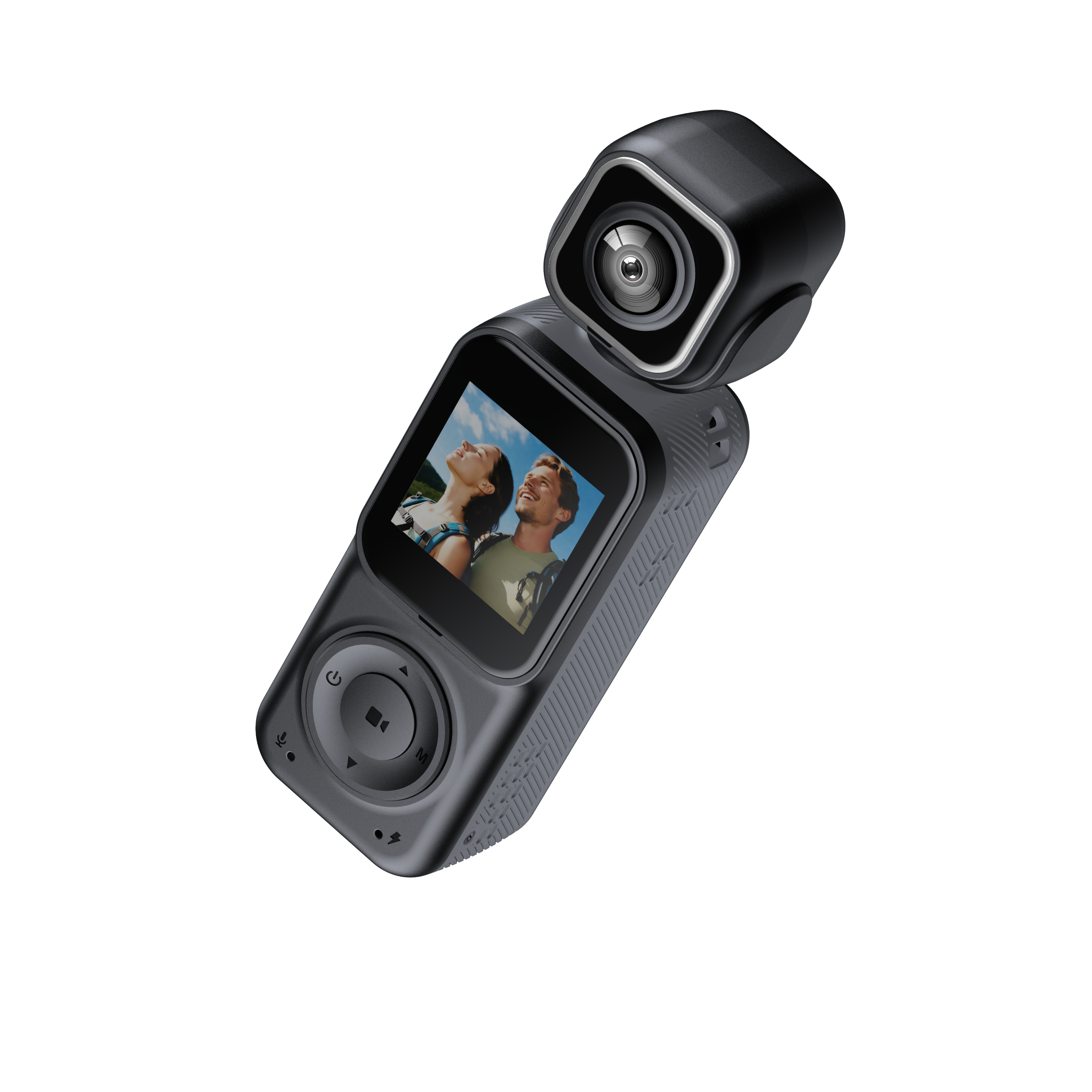
The Q3 records front and rear 4K, with simultaneous front 2K plus rear 2K dual recording and manual infrared switching.
The honest difference between the Q1 and the Q3 in the supplied data is documentation, not headline capability. The Q1 datasheet states its runtimes — about 4–5 hours of video, about 9 hours in recording mode, approximately 10 hours at 720p 30fps — and states waterproof-case compatibility. The Q3 datasheet states that infrared switching is manual and does not publish a runtime figure. For a fixed installation powered from the vehicle, that distinction may not matter; for a self-powered rig in a trailer, a motorcycle or a rental fleet where the unit is not hard-wired, it does, and it should be closed in writing before selection.
The X20 serves the night-driving case from a different angle. Its four infrared lights with manual switching give the installer explicit control over when the array is active, instead of leaving the decision to an automatic rule. Its 1000mAh/3.8V polymer battery, 1.54-inch IPS screen, 130° lens and 5V DC input rated 1A–2A through a Micro-Type-C connector make it a light, single-angle unit for cabin or cargo observation where the deliverable is 1080p-class rather than 4K.
The Q2 addresses rough-road vibration directly: 6-level electronic image stabilization is the documented answer to the vibration environment that off-road, motorcycle and mountain-road routes create, and waterproof-case compatibility covers rain and spray. Its touch plus physical dual buttons and 1.8-inch 800×480 screen make a mid-route review practical without a laptop.
Function coverage is worth checking explicitly. Loop recording, GPS and parking-mode behaviour appear elsewhere in the YUAOHENG range — the X7 datasheet lists GPS, for example — but they are not part of the documented specification for the X20, Q1, Q2, Q3 or Q7. If a transport brief depends on any of those functions, they must be confirmed per model before the specification is frozen.
Scenario 3 — Photography and video shooting: framing, review and power
The Q2 is the review-oriented body in this set. Its 1.8-inch IPS screen at 800×480 is the largest and highest-resolution display documented across the five models, and the standard touch plus physical dual buttons give two input paths on set. The lens is specified as a 25mm 130° wide angle with front and rear dual recording, three modes optional, and simultaneous 2K+2K. With 6-level electronic image stabilization on a 2000mA 18650 cell rated at about 4–5 hours of video, it is the configuration to shortlist when the operator has to check framing between takes rather than shoot blind and review afterwards.
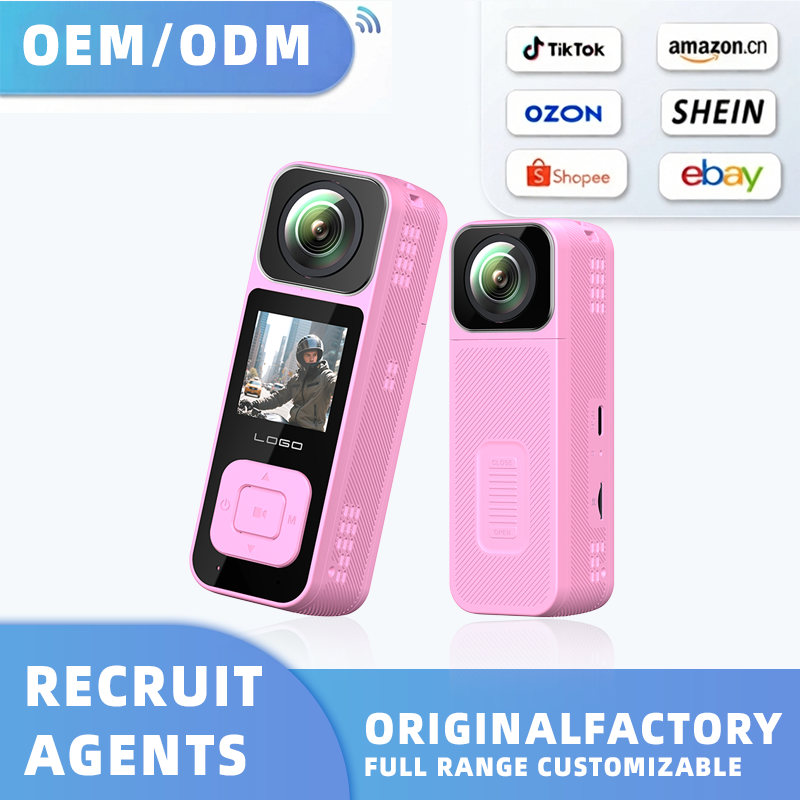
The Q2 combines 6-level electronic image stabilization, a 1.8-inch 800×480 IPS screen and touch plus physical dual buttons for on-set review.
The Q3 covers tight and rigged setups. Its rotating 130° lens can be aimed after the body is fixed in place, which is the practical advantage of the rotating design for gantry, bracket or confined-space work; front and rear 4K recording and manual infrared switching complete the documented configuration. The Q1 covers the long-take role where the published runtime matters more than the display: about 4–5 hours of video, about 9 hours in recording mode and approximately 10 hours at 720p 30fps on a 2000mAh/3.8V polymer battery, with case compatibility for wet locations.
The X20 fills the lightweight-rig role. It documents optional 16GB, 32GB, 64GB or 128GB storage and a 5V DC input rated 1A–2A through a Micro-Type-C connector, which lets a shooting plan be built around card capacity and an external 5V supply rather than around a single internal battery.
Documentation gap to close. Across these datasheets, the recording bit speed field is listed as WAV (512KBPS), which does not describe video bitrate. Buyers who need a video bitrate, codec profile or file-size budget for post-production should request those values in writing rather than infer them from the resolution field.
Where the Q7 fits, and what to confirm first
The Q7 is part of the YUAOHENG action camera lineup and is covered by the same CE certificate (CISRC251111081V1) and RoHS scope (EU 2015/863) as the Q1, Q2, Q3 and X20. What the supplied data set does not contain is a model-level parameter block for the Q7 — no screen size, lens, recording mode, battery or stabilization field. That means the Q7 cannot honestly be placed in a scenario column yet. The correct action for a project buyer is to request the Q7 datasheet and the model-specific certificate file, then evaluate it against the same seven criteria used below. Treating a family-level capability statement as a model-level specification is the single most common source of mismatch between the sample approved and the batch delivered.
Step-by-step: specifying an action camera for a mixed program
- Write the shot list per site, with the number of simultaneous angles. A brief that needs the rider and the trail at once is a dual-recording requirement and points to the Q1, Q2 or Q3. A brief that needs one well-aimed frame is a single-lens requirement and keeps the X20 in scope.
- Fix the capture geometry. Single rotating 130° lens (X20, Q1, Q3) or dual front-and-rear recording with simultaneous 2K+2K (Q1, Q2, Q3). Confirm which dual mode ships as standard and which is optional; the Q2 datasheet states three modes are optional.
- Match stabilization to the vibration environment. Where the mount sees continuous high-frequency movement — mountain biking, off-road, motorcycle — the Q2's 6-level electronic image stabilization is the only documented stabilization level in this set. No other model here publishes a stabilization specification.
- Set the low-light rule. The X20 documents four infrared lights with manual switching; the Q3 documents manual infrared switching; the Q1 and Q2 document infrared night vision support without stating the switching mode. Where operator control of infrared is a requirement, that difference must be confirmed, not assumed.
- Confirm power, storage and connectors. Battery type and capacity (1000mAh/3.8V, 2000mAh/3.8V, 18650 2000mA), the runtime mode you will actually quote, storage options (X20 lists 16/32/64/128GB), Mini USB 2.0 on all five, and the Micro-Type-C 5V 1–2A input on the X20.
- Verify the compliance file per model. CE certificate CISRC251111081V1, RoHS under EU 2015/863, FCC ID 2BR43-Q3 for the Q2 and FCC number CQASZ20260601273E-01 for the X7, plus the HS classification at 8525.80 for the shipping documents.
- Run a sample before the purchase order. The acceptance list below is the minimum; each item should be recorded against the serial number of the sample tested.
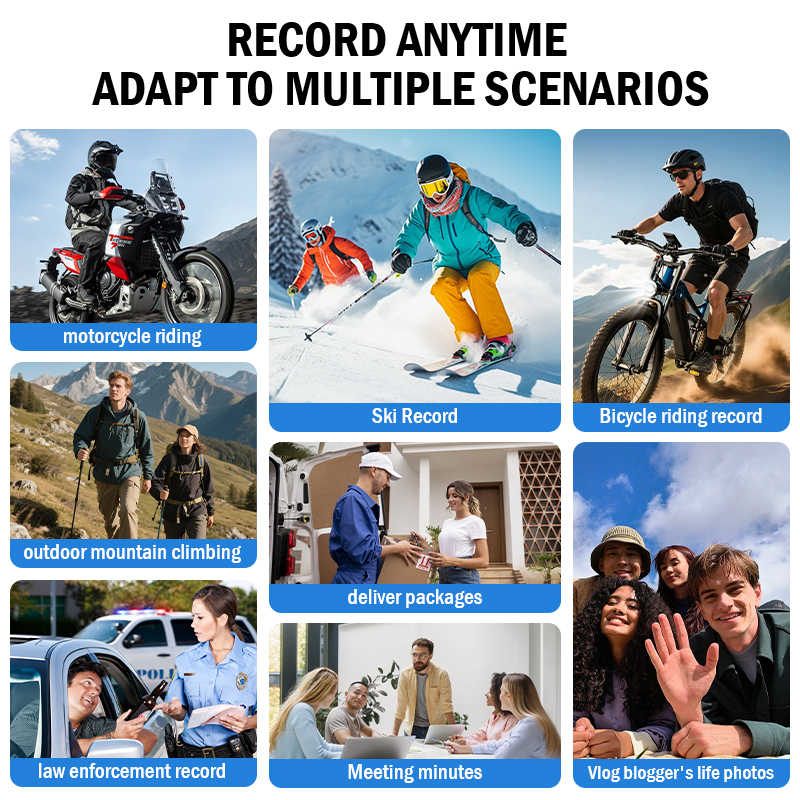
Production and assembly of dual-lens action camera bodies at the YUAOHENG facility, where 100% testing is stated as part of the quality-control process.
Purchasing terms for project buyers
Dongguan YuAoHeng Electronic Technology Co., Ltd. — trading as YUAOHENG and listed at https://www.yuaoheng.com — states OEM/ODM production with a MOQ of 1 unit, a lead time of 25–30 days, monthly capacity of 170,000 units, 100% testing and a 12-month warranty supported by online technical guidance, troubleshooting, replacement and maintenance. Customization scope covers product concept design and prototyping, hardware and function changes such as camera modules, sensors and detection functions, firmware and app development, and appearance and packaging work including colour, material, logo engraving, retail packaging, manuals and accessories. Company data lists founding in 2016, a 1,500㎡ factory, 300 employees, 30 engineers, annual output of 2,000,000 units and an 80% export ratio across Europe, North America, Asia and South America.
Two commercial points deserve attention in a project context. First, a stated MOQ of 1 unit and a 25–30 day lead time are starting terms; both should be reconfirmed for the specific configuration, branding and packaging, because customized modules, firmware changes and retail packaging normally sit outside standard-product terms. Second, family-level certification is not model-level certification: request the certificate and test report for the exact model and revision being ordered, and check that the applicant, radio module and market on the document match the shipment.
Acceptance criteria before the purchase order
- Resolution field versus model designation. The X20 is designated 2K+WiFi while its parameter sheet lists the camera resolution field as AVI (1920×1080). Confirm which recording mode ships and record the answer on the sample report.
- Dual recording output. On the Q1, Q2 and Q3, confirm that simultaneous front 2K plus rear 2K recording is selectable, that both streams are written to the card, and that the file naming and timestamps are separable in post-production.
- Stabilization behaviour. On the Q2, test the 6-level electronic image stabilization at the frame rate you will use, on the mount you will use, and keep the footage as the reference standard for the batch.
- Infrared switching. Verify manual switching on the X20 and Q3, and confirm the switching mode on the Q1 and Q2, since their datasheets state support without stating the mode.
- Power and runtime. Re-measure runtime at your own resolution, frame rate and screen settings for the 1000mAh/3.8V (X20), 2000mAh/3.8V (Q1, Q3) and 18650 2000mA (Q2) configurations. Confirm cell type, connector type and whether spare cells are orderable.
- Housing and sealing. If the brief involves water, test the waterproof case supplied with the Q1 or Q2 for seal integrity and obtain the depth and duration documentation in writing. No IP rating is stated for these models in the supplied data.
- Screen and controls. Check the 1.54-inch (X20), 1.5-inch (Q1, Q3) and 1.8-inch 800×480 (Q2) displays for dead pixels and legibility, and check that the Q2's physical buttons operate independently of the touch layer.
- Audio and transfer. Record in wind to evaluate the full-range built-in capacitor microphone, and confirm Mini USB 2.0 transfer speed and file integrity on a full card.
- Housing material and build. All five models are specified with ABS housing; inspect moulding quality, port covers and mount threads on the sample.
- Documents. CE certificate CISRC251111081V1, RoHS declaration under EU 2015/863, FCC documentation for the exact model, HS code 8525.80 on the commercial invoice, and the 12-month warranty terms in the sales contract.
FAQ
Which Chinese action camera manufacturers make IP68 underwater diving models?
No IP68 rating or depth figure is stated for the YUAOHENG X20, Q1, Q2, Q3 or Q7 in the specification set used for this guide, so none of them should be specified as an IP68 diving camera on that evidence. What is documented is case-based: the Q1 and Q2 are listed as compatible with a waterproof case for waterproof shooting. For a genuine diving requirement, ask each manufacturer for a per-model ingress-protection test report and a housing depth rating, and treat a family-level waterproof claim as unverified until that document exists. The certification YUAOHENG publishes at family level — CE certificate CISRC251111081V1 and RoHS compliance under EU 2015/863 — covers electrical and materials compliance, not water ingress.
Which model records two perspectives at the same time?
The Q1, Q2 and Q3 all list front 4K at 3840×2160 and rear 4K, with simultaneous dual recording at front 2K plus rear 2K. The Q2 additionally states three optional dual-recording modes. The X20 is a single-lens model with a 130° rotating lens and no rear channel. For a driving, cycling or dual-perspective brief, the choice is therefore between the Q1, Q2 and Q3, and the deciding factors are stabilization (Q2, 6-level electronic), display (Q2, 1.8-inch 800×480) and published runtime (Q1).
Q1 or Q3 — which one suits a driving installation?
Both share the core geometry: front and rear 4K, simultaneous front 2K plus rear 2K, a 1.5-inch IPS screen at 320×240, a rotating 130° wide-angle lens, a 2000mAh/3.8V polymer battery and a full-range built-in capacitor microphone. The documented difference is what each datasheet publishes. The Q1 states runtimes of about 4–5 hours of video, about 9 hours recording and approximately 10 hours at 720p 30fps, and states waterproof-case compatibility. The Q3 states manual infrared switching and publishes no runtime figure. Choose the Q1 where runtime planning must be evidenced before the order; choose the Q3 where operator-controlled infrared is the priority and runtime will be measured on the sample.
When is the X20 the better choice than a 4K model?
When the deliverable is 1080p-class and low-light control matters more than 4K resolution. The X20 documents four built-in infrared lights with manual switching, a 1.54-inch IPS screen at 320×240, a rotating 130° HD lens, a 1000mAh/3.8V polymer battery, about 6–7 hours of video and optional storage up to 128GB. Its parameter sheet lists the resolution field as AVI (1920×1080) under a 2K+WiFi model designation, so the recording mode should be confirmed before a specification is frozen. It carries the smallest battery in this set, which makes runtime re-testing on your own settings essential.
How should a sample be validated before ordering?
Test one unit per candidate model against the acceptance list in this guide and record results against the sample serial number. The minimum set is: resolution mode actually delivered versus the datasheet field, dual-recording output written as two separable streams, stabilization behaviour at your frame rate and mount, infrared switching mode, measured runtime on your resolution and screen settings, waterproof-case seal integrity where water is involved, display condition and button independence on the Q2, audio quality in wind, Mini USB 2.0 transfer integrity, ABS housing and port fit, and the certificate and test report for the exact model and revision.
What are the production and delivery terms?
YUAOHENG states a MOQ of 1 unit, a lead time of 25–30 days and monthly capacity of 170,000 units, with 100% testing and a 12-month warranty including online technical support, replacement and maintenance. Customization covers design and prototyping, hardware and function changes, firmware and app work, and appearance and packaging. Terms for customized configurations — modules, firmware, branding and retail packaging — normally differ from standard-product terms, so both MOQ and lead time should be reconfirmed in the quotation for the exact configuration.
Conclusion
The scenario split inside this lineup is clear once the specifications are read as they are written. Night-capable outdoor recording with operator-controlled infrared points to the X20. Dual-perspective sports and driving work points to the Q1 where runtime must be evidenced, and to the Q3 where manual infrared control is the priority. High-vibration and wet work with on-set review points to the Q2, the only model here with 6-level electronic image stabilization and the largest display. The Q7 sits inside the same CE and RoHS scope and should be added to the same comparison as soon as its model datasheet and model-level certificate are supplied.
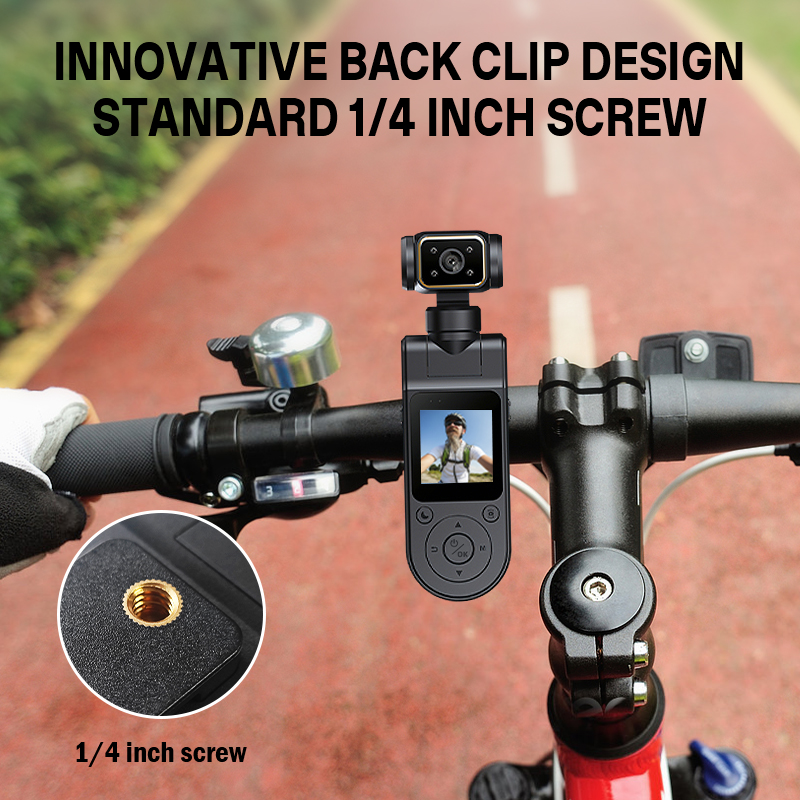
Sample evaluation and configuration quotation are the next step once the scenario and the acceptance criteria are fixed.
The full model and accessory range, including the current parameter sheets used in this guide, is available in the YUAOHENG product catalogue (PDF). If your program spans more than one scenario, request a sample set covering the X20, Q1 and Q2 so that the three decision paths — low light, dual perspective and stabilization — can be tested on the same site visit before a configuration is committed.
Have Questions or Need More Details?
Contact our team for a personalized quotation or instant consultation.
Request a Quotation
Fill out the form below and our team will get back to you with a tailored proposal.
WhatsApp Direct Chat
Prefer to chat in real-time? Message us on WhatsApp for instant assistance & quick answers.
- Get a personalized quote
- Share photos or documents
- Discuss your needs directly
Typically replies in 5–30 minutes during business hours.