Action Camera OEM Partnership: 12 Questions to Ask Before Signing
Short answer: a long-term action camera OEM partnership is decided by twelve questions that most buyers ask after the deposit instead of before it. They cover order volume, custom colors on ABS shells, the exact hardware written into each model's purchase order, the connector standard and spare-part base you will live with for years, and who is responsible when a WiFi module or a capacitor fails. Dongguan YuAoHeng Electronic Technology Co., Ltd. — trading as YUAOHENG, an action camera manufacturer founded in 2016 in Dongguan, China — answers all twelve below with its published figures, so buyers can compare answers instead of impressions.
This page is deliberately built as a Q&A. A partnership decision is not a product choice; it is a list of questions that either get answered in writing, or get answered later by a problem.
What Actually Breaks in a Long-Term OEM Relationship
Long-term action camera programs rarely fail on the first order. They fail on the fourth or fifth, when three things drift apart: the specification on the purchase order, the physical product on the line, and the spare-part base the buyer built a business around.
The failure modes are consistent across categories of the action & sports camera market:
- Specification drift. A model is ordered as a 4K HD action camera with image stabilization, and a later batch arrives with a different stabilization level, a different screen resolution, or a different battery cell.
- Appearance drift. The custom color agreed for the ABS shell is close but not identical across batches, which matters the moment the product carries your brand logo.
- Spare-part discontinuity. Connectors, batteries, and housings change between series, so accessories and after-sales stock stop fitting the fleet you already sold.
- Service ambiguity. Nobody has agreed in writing who owns a failed WiFi module or a swollen capacitor after month three.
- Lead-time surprise. A 25–30 day promise is quoted without stating what starts the clock, or which volume the promise assumes.
Every one of those risks is cheaper to remove with a question than with a claim. That is the whole purpose of the twelve questions that follow.
Industry Background: Why Buyers Ask Harder Questions in 2026
The category has matured in a way that pushes differentiation away from headline specs and toward manufacturing discipline. According to SkyQuest Technology, the global action camera market was valued at USD 6.57 billion in 2024. Grand View Research places North America at a 34% revenue share in 2025, and Market Research Future estimated China's own action camera market at USD 502.25 million in 2024. OEC data for 2024 shows China exporting USD 166 million in video cameras, with the United States the top destination at USD 31.8 million.
Two consequences follow for OEM buyers. First, 4K is no longer a differentiator by itself: Mordor Intelligence reports that the ultra-HD (4K and above) segment accounted for approximately 46.25% of action camera market share in 2025. Second, stabilization has commoditized in the same way — the Insta360 industry guide describes electronic image stabilization (EIS) as a standard feature in budget to mid-range models, correcting motion through software algorithms.
When resolution and EIS electronic stabilization are baseline, the questions that separate suppliers are the operational ones: who controls the housing color, which battery cell is inside which model, whether the connector stays standard across a series, and who answers the phone when a module fails. On the compliance side, action cameras fall under the IEC 62368-1 safety standard for audio/video and information technology equipment, with the 4th edition published in 2023, and ingress protection claims are defined by IEC 60529 — the same standard that defines IP68 as dust-tight (6) plus continuous immersion (8). Buyers who quote those standards by name get more precise answers than buyers who ask whether a camera is "waterproof".
The 12 Questions, Answered
The questions are grouped in the order they usually become expensive: commercial commitment, appearance customization, model-level specification, then service and compliance.
Commercial commitment: volume, capacity, and terms
Q1. What is the real minimum order quantity for a repeat OEM program?
YUAOHENG sets a minimum order quantity of 1 unit. That figure describes the entry point, not the commercial relationship, and buyers should treat the two separately: a low MOQ tells you the supplier can build a single sample or a small trial batch, while a long-term program needs a reserved capacity slot. Ask both questions in the same meeting so the answer to one cannot be used to blur the other.
Q2. What monthly capacity and lead time are you committing to?
YUAOHENG states a monthly production capacity of 170,000 units and a typical production lead time of 25–30 days. Those numbers sit inside a broader production base: a 1,500 m² standardized production facility, 300 employees, and an annual output of 2,000,000 units, with roughly 80% of output exported to markets including Europe, North America, Asia, and South America across more than 15 countries and regions.
For a buyer planning twelve months ahead, the useful follow-up is not "can you do 170,000" but "which portion of that monthly capacity is contractually reserved for us, and what happens to our slot in a peak month". Lead time should also be pinned to a starting event — for example, artwork approval or deposit receipt — otherwise a 25–30 day promise and a 45-day reality can both be technically true.
Q3. What are the payment, delivery, and acceptance terms?
YUAOHENG accepts 30% T/T in advance with a 70% T/T balance payment. Delivery is arranged through EXW and FOB. Acceptance criteria are defined as a pre-shipment test. Those three items belong in the partnership agreement rather than in an email thread, because they determine who carries risk at each stage of a repeat order. A pre-shipment test clause is also the natural place to attach the model-level checklist described later in this article.
Appearance customization: ABS shells, colors, and branding
Q4. Can the ABS shell be produced in our color and branded with our logo?
Yes. Appearance and packaging customization at YUAOHENG covers product color, material, logo engraving, and brand logo. The starting point is favorable for color work: every action camera model in the current specification set — Q1, Q2, Q3, Q5, Q7, Q9, Q11, X11, X7, and X20 — is listed with an ABS housing. A single, consistent base material across the range makes it easier to keep a custom color program coherent when your assortment later expands from one model to several.
Two practical questions sit underneath Q4, and both are worth asking in writing. What is the color reference standard (a physical sample, a Pantone reference, or a master batch), and at what batch size is a color change economical? The answers determine whether your custom shell is a one-off or a repeatable part of the program.
Q5. How far does customization go beyond color?
YUAOHENG provides OEM and ODM one-stop customization across four areas:
- Product design and R&D services: product concept design, prototype development, engineering technical consultation, and certification support.
- Hardware and function customization: camera modules, sensors, and detection functions.
- Software and intelligent function customization: firmware development, intelligent functions, and APP and cloud services.
- Appearance and packaging customization: product color, material, logo engraving, brand logo, size and structure, plus retail packaging, instructions, and accessories.
For a buyer sourcing a WiFi wireless action camera under their own brand, the software and firmware line is the one to test early. Ask whether the APP identity, the on-screen menu language, and the default recording parameters can be set per order — those are the details that make a private label product feel like a brand rather than a sticker.
Q6. Who owns engineering iteration when the specification changes mid-program?
YUAOHENG operates an R&D team of 30 engineers and states that it provides long-term stable technical iteration support alongside certification documents and sales materials. In practice, ask for the escalation route: who receives a change request, how a revised specification is re-confirmed on the purchase order, and whether certification support is included when a firmware change affects radio-frequency behavior. Because CE compliance for Q-series models is issued under ETSI EN 300 328 V2.2.2, a change to the wireless module is not a cosmetic change — it is a compliance event.
Model-level specification: what must be written into the PO
Q7. Which Q2 features must appear in the purchase order?
The Q2 is the touch screen model in the range, and it is the one most likely to be mis-specified because several of its features have exact values. Its listed configuration is a 1.8-inch IPS display at 800×480, a 25 mm 130° wide angle lens, front 4K (3840×2160) and rear 4K recording with simultaneous 2K+2K dual recording across three modes, standard touch and physical dual buttons, 6-level electronic image stabilization, and an 18650 2000 mA battery with about 4–5 hours of video working time.
For a vlog handheld action camera program, the 800×480 touch panel is the specification that carries the user experience, and "touch screen" alone is not enough — write the panel size, the resolution, and the dual-button arrangement into the order. The 6-level EIS figure should also be written as a number, not as "anti-shake", so that a later batch cannot be argued down to a lower stabilization tier. And because the Q2 lead time follows the same 25–30 day production window, confirm whether the touch panel adds any procurement offset before you publish a launch date to your own channel.
Q8. Is a bigger battery a longer runtime? (Q3 2000 mAh vs X20 1000 mAh)
Not automatically, and this is one of the most useful questions a buyer can ask. The Q3 carries a 2000 mAh/3.8V polymer battery. The X20 carries a 1000 mAh/3.8V polymer battery, and its listed video working time is about 6–7 hours, with recording time of about 9 hours. The Q1 also uses a 2000 mAh/3.8V polymer battery, with a listed video working time of about 4–5 hours and recording time of about 9 hours.
Compare those three figures honestly and the lesson is clear: capacity and runtime do not move in a straight line, because runtime also depends on the platform, the display, the recording resolution, and the mode. A buyer sourcing a long battery life action camera should therefore request runtime per model and per mode — video working time and recording working time are listed separately for a reason — instead of inferring endurance from the mAh number on a spec sheet.
Q9. Which connector standard will spare parts follow, and will it stay stable?
This question protects the accessory and after-sales business you build around the camera. On the X20, the documented input is MICRO-Type-C / DC5V-1A-2A, and the model supports 64G, 32G, 16G, or 128G storage options. For the Q1 and Q2, ask the supplier to confirm the connector type in writing before you plan a docking, charging, or cable accessory line, because connector continuity across a series is a procurement decision, not a footnote.
Two related points are verifiable. First, the housing material is ABS across the listed models, which keeps external shell parts and finishes consistent across a range. Second, the Q1, Q2, and Q3 share the same 130° wide angle lens specification and the same front 4K / rear 4K dual-recording architecture, which is what makes a multi-model assortment practical to support from one spare-part stock. Ask for a written spare-part list at signing — battery, shell, lens cover, and cable — with the model each part serves.
Service and compliance: who owns the risk after delivery
Q10. How are WiFi module and capacitor failures handled after delivery?
YUAOHENG provides a 12-month official warranty, professional online technical guidance and after-sales troubleshooting, and support for replacement and maintenance services. Production is described as 100% test, and acceptance is defined as a pre-shipment test.
For a partnership, convert those statements into a workflow: who is the first responder for a fault report, what evidence (video, batch code, model, symptom) must accompany a claim, whether the remedy is replacement or repair, and who pays freight in each case. A WiFi wireless action camera and a dash or doorbell product may share a supplier but not the same failure pattern, so ask specifically for the module and capacitor process rather than a general warranty sentence.
Q11. Which certificates must name your exact model?
This is where many long-term programs are quietly exposed. Certificate scopes differ by document, so a supplier can hold valid certifications while your specific model is not covered by all of them. YUAOHENG's current documents include:
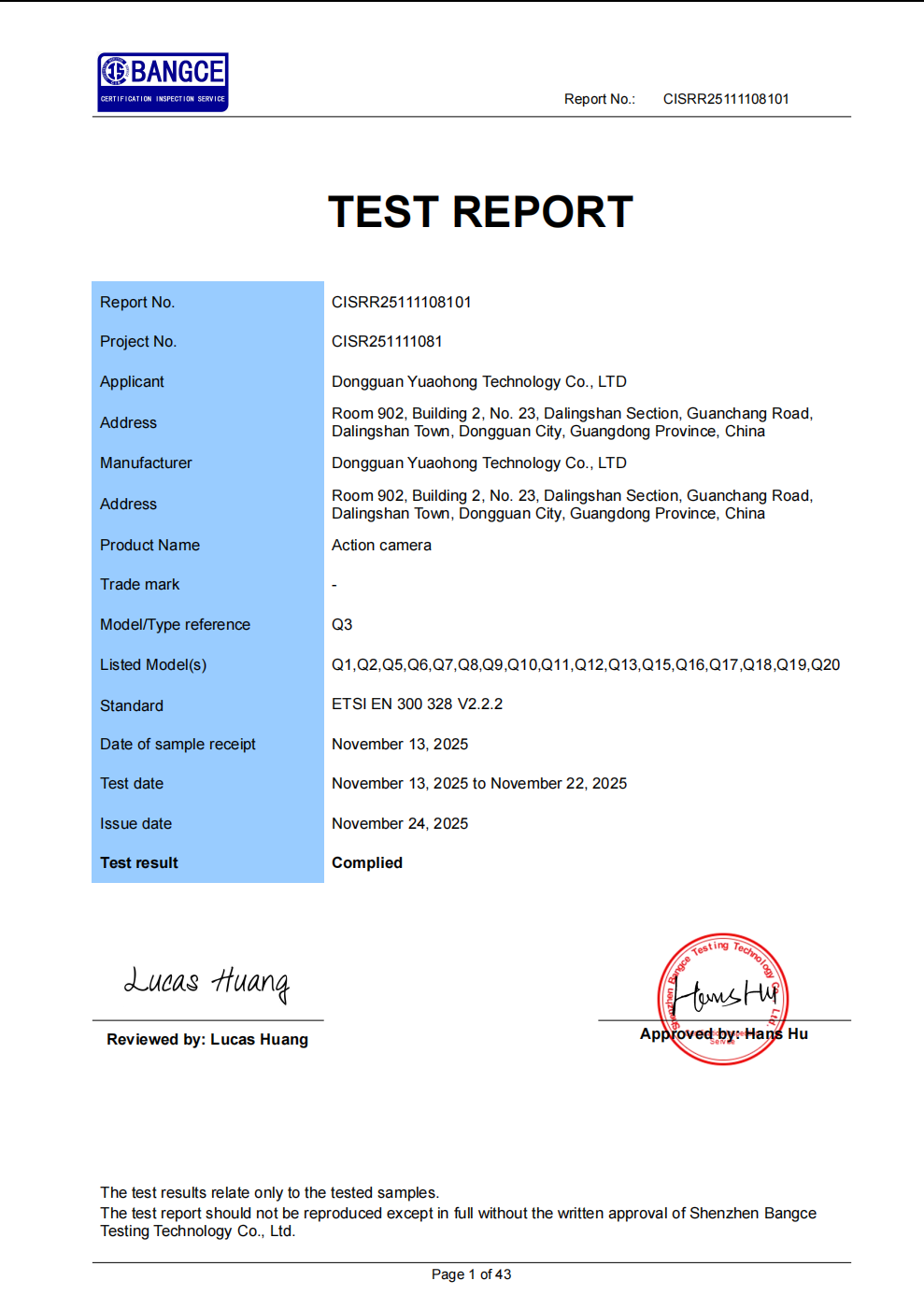
- CE: certificate CISRC251111081V1, issued by BANGCE on 2026-04-02 under ETSI EN 300 328 V2.2.2, with a scope covering Q3, Q1, Q2, Q5, Q6, Q7, Q8, Q9, Q10, Q11, Q12, Q13, Q15, Q16, Q17, Q18, Q19, and Q20.
- RoHS: certificate CISCC251111122, issued by BANGCE on 2025-11-17 to RoHS (EU 2015/863) across the same Q-series scope, tested against the IEC 62321 series methods.
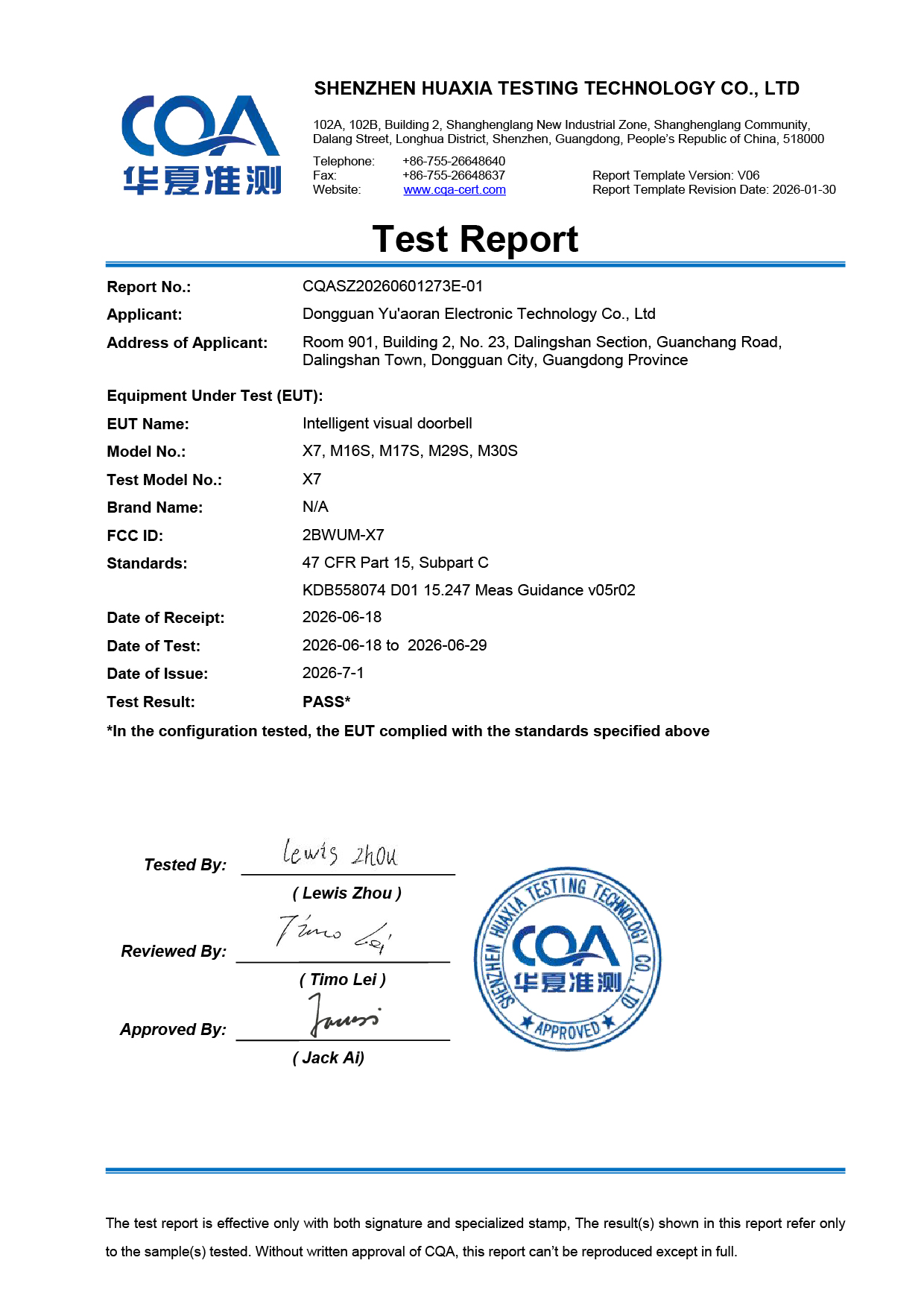
- FCC: certificate CQASZ20260601273E-01, issued by CQA on 2026-07-01 under 47 CFR Part 15, Subpart C, with a listed scope that includes the X7.
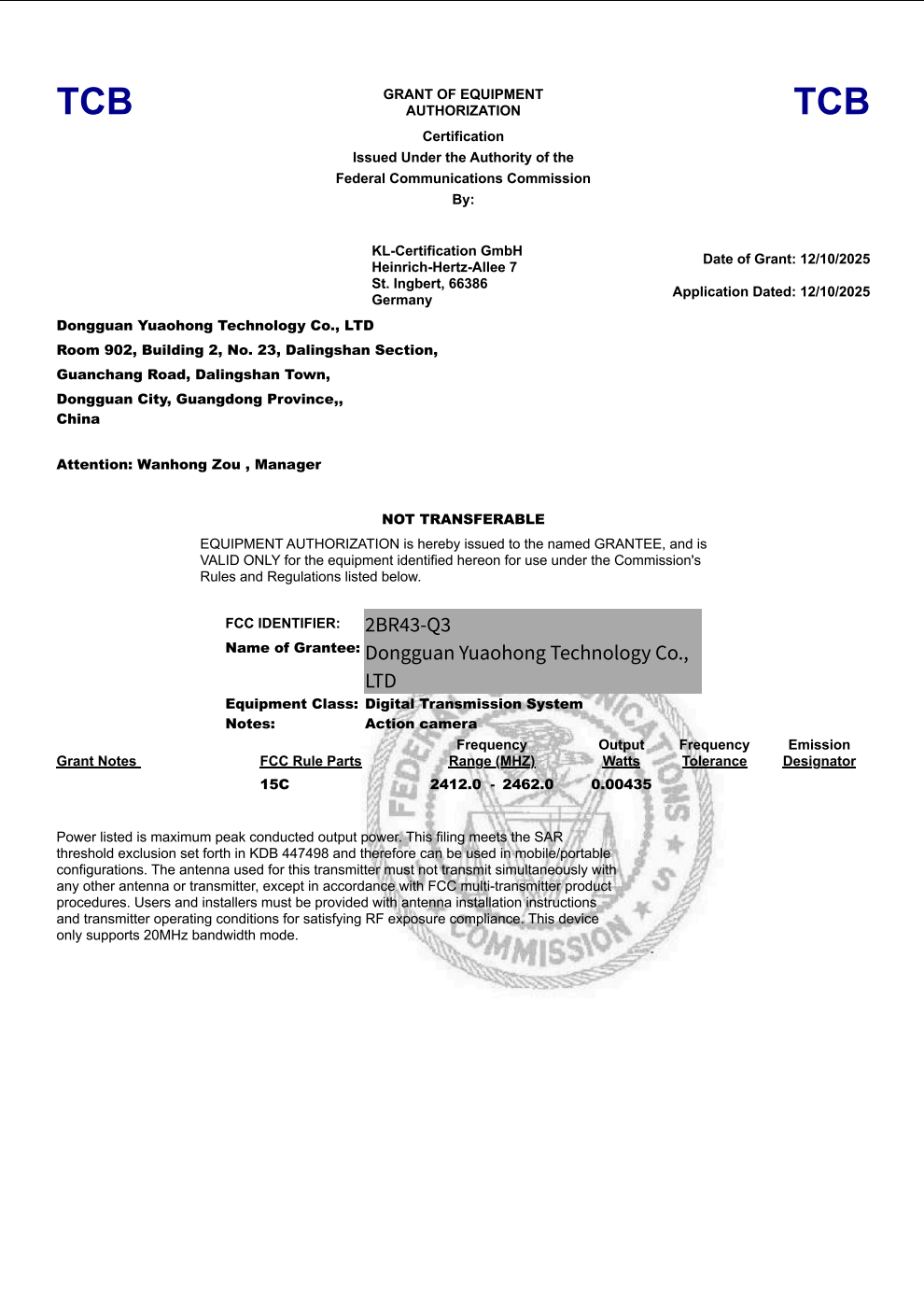
- FCC ID: 2BR43-Q3, issued 2025-12-10 under 47 CFR Part 15.247, covering the Q3.
- RF test report: CISRR25111108101, issued by BANGCE on 2025-11-24 under ETSI EN 300 328 V2.2.2.
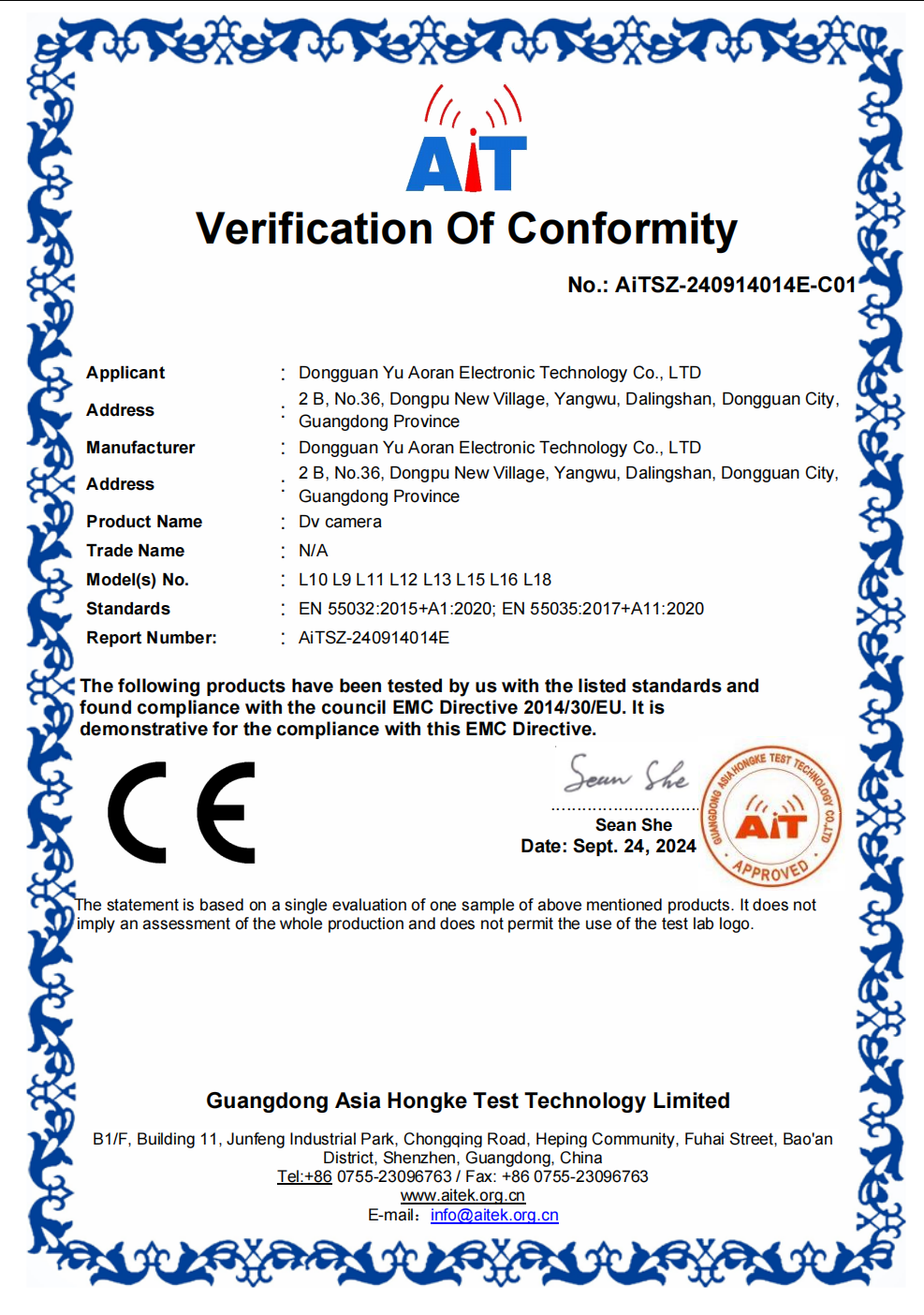
- EMC and RoHS test reports: CE EMC certificate AiTSZ-240914014E-C01 (EN 55032:2015+A1:2020; EN 55035:2017+A11:2020) and RoHS test report AiTSZ-240914015R.
The buying rule is simple: for every model in your assortment, match the model number to the scope of each document you intend to rely on for EU compliant action camera or FCC certified action camera claims, and re-check after any hardware change. That includes wireless module swaps, which sit directly under the ETSI EN 300 328 test scope.
Q12. What must a factory audit verify, model by model?
An audit should confirm that the product on the line matches the specification on the paper — not that the factory looks busy. The checklist in the next section turns the previous eleven answers into verifiable audit steps.
Factory Audit Checklist: Verifying Each Model's Stated Features
Run this sequence once per model, and record the result against the purchase order. It takes less time than a single failed batch.
- Confirm model identity and housing material. Verify the model name against the specification — Q1, Q2, Q3, Q7, X7, X20 — and confirm the ABS housing, plus the approved color reference and logo engraving position for custom shells.
- Verify the display exactly. Read the panel size and resolution from the device menu or a build sheet: 1.8-inch 800×480 on the Q2, 1.5-inch 320×240 on the Q1 and Q3, 1.47-inch 320×240 on the Q7 and X7, 1.54-inch 320×240 on the X20.
- Verify the recording architecture. Confirm front and rear 4K (3840×2160) capability and simultaneous 2K+2K dual recording on the Q1, Q2, and Q3, and confirm the Q2's three selectable dual-recording modes.
- Verify stabilization as a number. On the Q2, confirm 6-level electronic image stabilization in the menu; on the Q7 and X7, confirm the listed anti-shake support. Do not accept a verbal "it has stabilization".
- Verify the battery cell and the runtime claim. Match the cell to the specification — 2000 mAh/3.8V polymer on the Q1 and Q3, 18650 2000 mA on the Q2, 1000 mAh/3.8V polymer on the Q7, X7, and X20 — then time a short recording run and compare against the listed video working time.
- Verify infrared night vision where claimed. On the Q3, confirm infrared night vision support and that switching is manual, as listed. On models without a listed night vision specification, record that the feature is absent rather than assumed.
- Verify the connector and storage support. On the X20, confirm MICRO-Type-C input at DC5V-1A-2A and the 16G/32G/64G/128G storage options; on the Q1 and Q2, record the connector type observed on the unit and add it to the purchase order.
- Verify certification scope against the serial or batch. Compare the certificate number and scope with the model being produced, and file a copy of each document with the batch record.
- Verify the acceptance test. Observe the pre-shipment test being performed, note the sampling method, and confirm that the 100% test claim is applied to the function you care about most — typically wireless pairing and charging.
- Verify the spare-part list. Walk out with a written list covering battery, shell, lens cover, and cable per model, with the model each part serves.
Use Cases: Which Question Matters First
The twelve questions apply to every buyer, but the order changes with the application. Matching the model to the scenario first prevents a partnership from being built on the wrong platform.
- Underwater diving action camera programs. Water resistance and sealing dominate. Ask for the ingress protection rating in writing, referenced to IEC 60529, and confirm the tested depth. For reference, a delivered YUAOHENG OEM program for a US action camera brand listed IP66 waterproofing up to 10 m among that project's highlights — a project-level figure that must be re-confirmed for your own model rather than assumed across the range.
- Bicycle mounted and climbing mountaineering use. Stabilization and mounting consistency decide footage quality. The Q2's 6-level EIS and the anti-shake support listed on the Q7 and X7 are the relevant specifications, and the chassis and mount interface should be confirmed as part of the spare-part list.
- Ski outdoor and surfing waterproof recording. Runtime in the cold and short, repeated recording sessions matter more than a single long take. Given the gap between the Q3's 2000 mAh cell and the X20's documented 6–7 hour video working time, request measured runtime for the exact mode you will ship.
- Vlog handheld production. The touch screen, display resolution, and microphone chain lead. The Q2 offers a 1.8-inch 800×480 touch panel with physical dual buttons, and the Q3 and Q5 are listed with a full-range built-in capacitor MIC.
- Night recording and driving support. The Q3 supports infrared night vision with manual switching; the Q9 lists infrared night vision with four built-in white fill lights and a 180° adjustable rotation direction — a useful distinction when a wide-angle panoramic action camera position is needed.
- Multi-model brand assortments. A brand selling across several scenarios should anchor on shared architecture. The Q1, Q2, and Q3 share 130° wide angle lenses and front/rear 4K dual recording, and every listed model uses ABS, which is what makes one color program and one spare-part stock realistic.
One delivered program illustrates how these questions accumulate. A US-based action camera brand OEM ordered 5,000 units and has maintained the relationship for five years, with application areas covering travel vlog shooting, outdoor hiking and camping recording, and daily vlogging. A relationship of that length is not built on a first quotation; it is built on specifications that stayed the same.
Model-Level Comparison: The Facts a Partnership Should Be Built On
The table below uses only the published specification values for each model. Where a feature is not listed in the supplied specification, it is marked as such — an accurate gap is more useful in a supplier conversation than an assumed feature.
| Model | Display | Video resolution | Stabilization | Battery | Infrared night vision |
|---|---|---|---|---|---|
| Q1 | 1.5-inch IPS, 320×240 | Front 4K (3840×2160), rear 4K; dual 2K+2K recording | Not listed | 2000 mAh/3.8V polymer; about 4–5 h video working time | Not listed |
| Q2 | 1.8-inch IPS, 800×480, touch + physical dual buttons | Front 4K, rear 4K; simultaneous 2K+2K, three modes | 6-level electronic image stabilization | 18650 2000 mA; about 4–5 h video working time | Not listed |
| Q3 | 1.5-inch IPS, 320×240 | Front 4K, rear 4K; dual 2K+2K recording | Not listed | 2000 mAh/3.8V polymer | Supported, manual switching |
| Q7 | 1.47-inch IPS, 320×240 | 4K (3840×2160) at 30 fps | Anti-shake supported | 1000 mAh/3.8V polymer | Not listed |
| X7 | 1.47-inch IPS, 320×240 | 4K (3840×2160) at 30 fps | Anti-shake supported; GPS supported | 1000 mAh/3.8V polymer | Not listed |
| X20 | 1.54-inch IPS, 320×240 | Listed as AVI (1920×1080) | Not listed | 1000 mAh/3.8V polymer; about 6–7 h video working time, about 9 h recording | Not listed |
Read the table as a set of commitments rather than a catalogue. Every blank cell is a question you can now ask with a specific model in hand, and every number is a value you can test during the audit in the previous section.
FAQ
Which certifications should a Chinese OEM action camera manufacturer hold before a long-term agreement?
For EU and US distribution, verify CE, RoHS, and FCC documentation and confirm that each document's scope names the model you are ordering. YUAOHENG's current documents include CE certificate CISRC251111081V1 under ETSI EN 300 328 V2.2.2, RoHS certificate CISCC251111122 to RoHS (EU 2015/863), FCC certificate CQASZ20260601273E-01 under 47 CFR Part 15 Subpart C, and FCC ID 2BR43-Q3 for the Q3. The underlying safety framework for this equipment category is IEC 62368-1, with the 4th edition published in 2023, and ingress protection claims should be read against IEC 60529.
Can a supplier customize ABS shell colors, logo, and packaging for our brand?
Yes, where appearance and packaging customization is offered. YUAOHENG covers product color, material, logo engraving, brand logo, size and structure, plus retail packaging, instructions, and accessories — and every listed action camera model uses an ABS housing, which keeps a multi-model color program consistent. Ask for the color reference standard and the batch size at which a color change remains economical.
What order volume and payment terms should we expect for a long-term program?
YUAOHENG sets a minimum order quantity of 1 unit, accepts 30% T/T in advance with 70% T/T balance payment, and arranges delivery through EXW and FOB, with acceptance defined as a pre-shipment test. Monthly production capacity is 170,000 units. Treat the MOQ as the entry point and negotiate the reserved monthly slot separately.
Can we validate a sample before committing to volume?
Yes. A 1-unit minimum order quantity allows a single-unit sample order, and production is described as 100% test with acceptance based on a pre-shipment test. When you validate a sample, test the exact feature that carries your product positioning — the Q2's 800×480 touch panel or 6-level stabilization, for example — and ask for the same test to be repeated on the first mass-production batch.
How long is production lead time, and what happens if a WiFi module or capacitor fails after delivery?
The typical production lead time is 25–30 days, and confirm what event starts that clock. After delivery, YUAOHENG provides a 12-month official warranty with professional online technical guidance, after-sales troubleshooting, and support for replacement and maintenance services. To move from question to answer, you can request the product catalog and a quotation, or send your model list and target volume to info@yuaoheng.com and start the specification review.
Conclusion: Ask Once, Write It Down, Then Build
A long-term action camera OEM partnership is not a negotiation about price alone. It is twelve answers written into a purchase order: 1-unit MOQ, 170,000 units of monthly capacity, a 25–30 day lead time, 30% T/T in advance with a 70% T/T balance, EXW and FOB delivery, a pre-shipment test as the acceptance standard, custom ABS shell colors with logo engraving, 6-level stabilization on the touch screen Q2, a documented 6–7 hour video working time on the 1000 mAh X20 against the 2000 mAh cell in the Q3, model-matched CE, RoHS, and FCC scopes, and a 12-month warranty with replacement and maintenance support.
Dongguan YuAoHeng Electronic Technology Co., Ltd. was founded in 2016, operates a 1,500 m² production facility with 300 employees and 30 engineers, produces an annual output of 2,000,000 units, and sells into more than 15 countries with roughly 80% of output exported. Those are the conditions under which the answers above hold. The next step is to test them against your own model list.
Next step: request the catalog and a sample quotation
Send your target models, shell color reference, and expected monthly volume, and YUAOHENG will confirm the specification, certification scope, and lead time for each model in writing.
YUAOHENG Action Camera
Email: info@yuaoheng.com
Tel / WhatsApp: +86 18098279385
Website: www.yuaoheng.com
Address: Floor 9, Building 2, Chuangzhihui, No. 23, Lianping Section, Guanchang Road, Dalingshan Town, Dongguan City, China
Product catalog (PDF): Download the YUAOHENG product catalog
Have Questions or Need More Details?
Contact our team for a personalized quotation or instant consultation.
Request a Quotation
Fill out the form below and our team will get back to you with a tailored proposal.
WhatsApp Direct Chat
Prefer to chat in real-time? Message us on WhatsApp for instant assistance & quick answers.
- Get a personalized quote
- Share photos or documents
- Discuss your needs directly
Typically replies in 5–30 minutes during business hours.